Running poles used to be a hiking thing you’d never see on a start line. That’s changed. Vertical kilometre races, mountain ultras and anything with serious climbing now have poles strapped to half the field, and for good reason once you understand what they actually do on a climb. This guide covers trail running poles specifically, not the walking poles gathering dust in the garage, working through when to use them, what size actually fits you, and how to use them properly rather than just carrying dead weight uphill.
What’s the Difference Between Running Poles and Hiking Poles
Hiking poles are built to be adjustable, heavy enough to lean on all day, and telescope down from thick sections that clip together with a twist lock. Running poles do the opposite job. They’re built to disappear into a vest pocket the second you stop needing them, which means folding rather than telescoping, usually into three or four thin sections connected by an internal cord, similar to a tent pole. Weight matters more too. A trekking pole holding your full bodyweight on a steep descent needs to be sturdy. A running pole only needs to hold your weight for the half second your hand is pushing off, so anything that isn’t load bearing for that instant gets stripped out. That’s why carbon fibre shows up so often in trail running poles and rarely in a budget hiking pole. It’s stiffer for its weight, and weight is the entire point.
When Should You Use Trail Running Poles
Poles earn their place the moment a climb gets steep enough that your hands would rather be on your knees. On anything gentle, most runners are faster without them, since planting and recovering a pole costs more energy than it saves. Push onto a longer, sustained climb and the maths flips. You’re using your arms and shoulders to share load that would otherwise sit entirely on tired quads, which matters far more at mile 60 of an ultra than mile 6. Technical, loose or wet descents are the other obvious case, where a pole plant is the difference between staying upright and going down hard on scree. Races like UTMB, the Spine Race, Hardrock 100, MDS and UTCT either mandate poles in the kit list or make them close to essential given the vert involved, which tells you plenty about when poles for trail running actually pay off.
What Size Running Poles Do I Need
What size running poles do I need is usually the first practical question once you’ve decided poles are worth trying. Fixed length poles need matching to your height from the start, since there’s no adjustment once you’re out on the trail. The OMM Z-Lite Poles handle this by offering the same pole in five different lengths, each marked with a different coloured wrist strap so you can tell them apart in a kit bag. The same design is also available in carbon if you want the lighter build without changing how the pole sizes and folds. Adjustable poles solve the sizing problem differently. The Dynafit Ultra Pro Pole adjusts between 115 and 135cm, covering most adult heights without needing a separate size on the shelf for everyone. As a rough starting point, grip a pole with the tip on the ground next to your foot. Your elbow should sit at close to a right angle. Too short and you’re bent forward reaching for the ground. Too long and the pole does nothing useful above waist height.
How to Use Running Poles Effectively
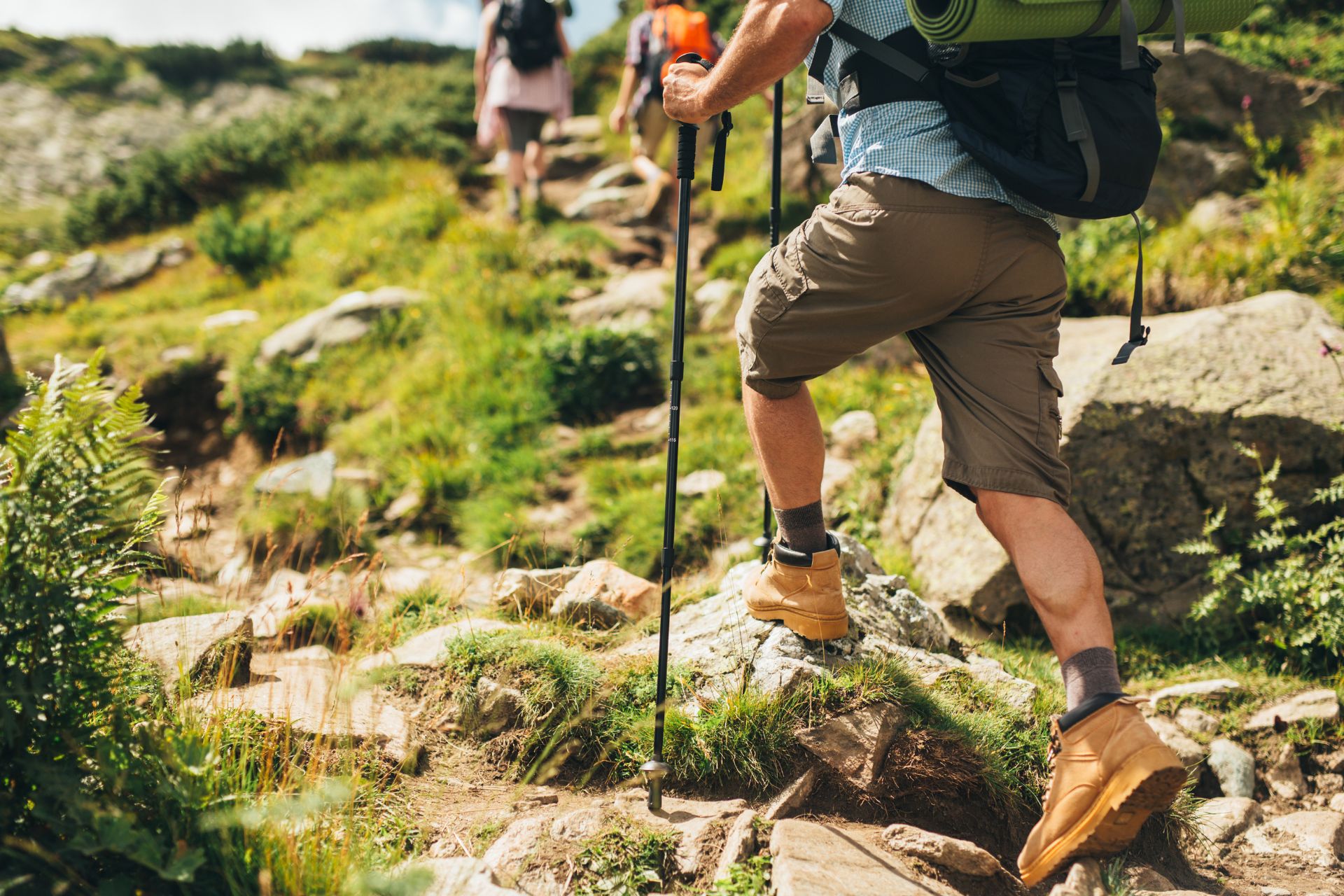
Poles that just tap the ground next to your feet aren’t doing much. The push needs to come from a full arm extension, planting slightly ahead of your foot and driving back past your hip before you lift and reset. That’s what actually transfers load off your legs. Your hand should sit up through the wrist strap rather than gripped tight around it, so the strap does some of the holding and your grip stays relaxed on the climb. The moment the gradient eases off, stow them. Dragging poles across flat ground burns more energy than it saves, and a pole in each hand on a technical downhill is sometimes worse than no poles at all. Most folding poles pack down small enough to strap to a vest in seconds, which is the entire point of choosing folding over telescoping.
Do Elite Ultra Runners Use Poles?
Yes, and increasingly without much debate about it. A decade ago poles at the elite end of ultra running were unusual outside specific mountain events. Now they’re standard kit at anything with serious vertical gain, since the time saved on sustained climbs outweighs whatever speed you lose carrying them on the flat. Kilian Jornet uses them. So does most of the UTMB podium most years. It’s not a crutch for runners who can’t otherwise manage the distance. It’s a tool that measurably moves split times on the climbs mountain ultras are built around. The debate that still exists is which poles, carbon versus aluminium, fixed versus adjustable, not whether to carry them at all.
What to Check Before You Buy Trail Running Poles
There’s no single best trail running poles pick that suits every runner, only trade-offs that matter more or less depending on your race. Here’s what actually decides which pair is right for you.
- Material. Carbon fibre poles like the SkyRunner RaceDay and the aluminium Trail Blaze sit at opposite ends of the same trade-off. Carbon saves real weight felt on every single pole swing across a multi-hour race, while aluminium survives a rock strike better and costs less, which is why it’s still the sensible pick for training miles.
- Fixed length or adjustable. A fixed length pole is lighter and simpler with one less moving part to fail mid-race, provided you’ve bought the right length. An adjustable pole suits anyone sharing poles, running varied terrain, or who doesn’t want to commit to one length forever.
- Number of sections. Three section poles fold down slightly bulkier than four section poles, which matters if you’re stowing them in a running vest rather than carrying them in your hand for the whole race.
- Grip and strap system. An ergonomic foam grip with a proper wrist strap, not just a bare handle, is what lets you relax your hand on a long climb instead of gripping through fatigue. The SkyRunner Edge builds the strap into an integrated glove system, so there’s nothing loose to fumble with mid-stride.
- Tip type. Tungsten carbide tips grip rock and hard ground properly and don’t wear down the way a softer tip does, which matters more the longer and rockier the race gets.
That’s how to choose trail running poles once you know what you’re actually running and how far. If footwear is next on your list, our guide to what are trail running shoes covers lug depth and grip in more detail.
Trail Running Poles Ready When You Are
Whichever combination of material, length and grip suits your next race, the full running poles and accessories range is worth a proper browse before you commit. Get the size right first, then let the terrain decide the rest.